Testing Business Ideas - From Idea to Validated Business Model

Introduction
In order to be successful on the market in the long term, companies must continuously develop new business concepts. These make it possible to optimize existing business models, fundamentally change them or create completely new approaches. However, before significant investments are made, every business idea should be reviewed through systematic validation in order to significantly improve the chances of success.
Research results show that around 70% of all new business concepts fail. These sobering statistics underline the significant risks associated with bringing unproven business ideas to market. This is where the Testing Business Ideas approach developed by Bland, Osterwalder and Smith from Strategyzer becomes interesting.
What is “Testing Business Ideas”?
Testing Business Ideas refers to the systematic review of a business idea concerning feasibility, market potential and profitability before actual implementation. The aim is to identify potential risks and challenges at an early stage in order to create a solid basis for success.
New business ideas naturally carry high risks of failure. However, systematic experimentation can significantly reduce uncertainty. Repeated tests provide valuable feedback and insights that enable targeted optimization and adjustment to target group needs. This data-based approach uncovers weaknesses before major investments are made.
Step by step to successful validation
Business Idea Testing works as an iterative process involving continuous testing and adaptation until the business concept is ready for the market. This approach significantly minimises risks and errors, thereby increasing the chances of success for new ventures or products.
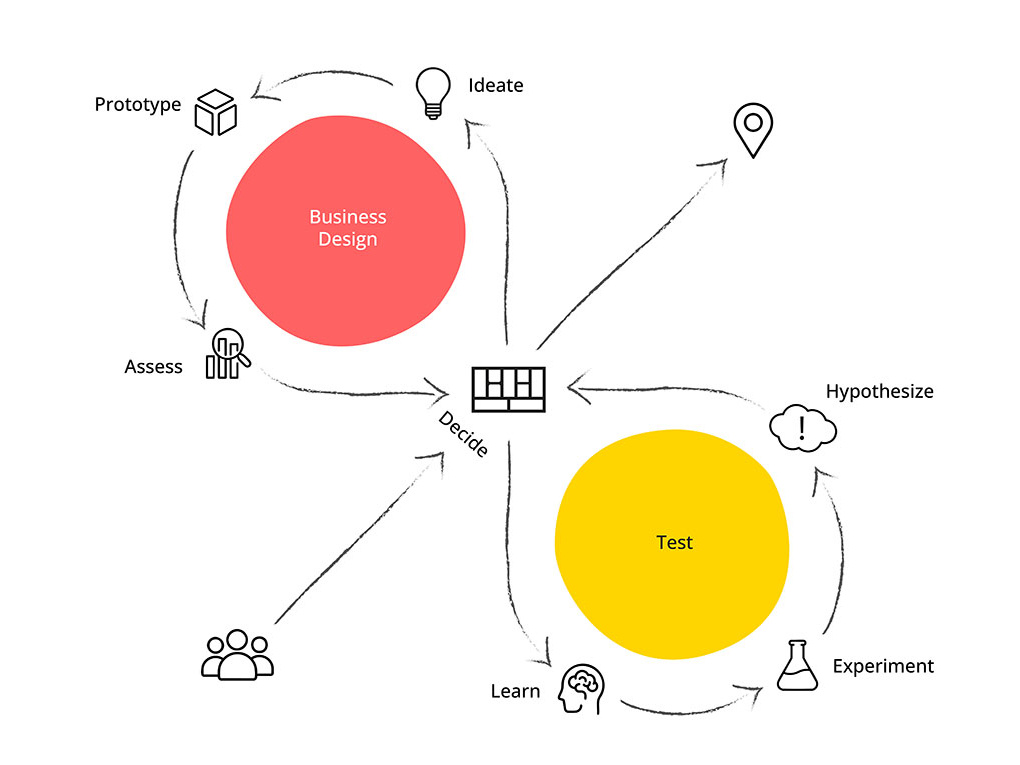
This process is divided into two “loops”:
- Business Design Loop (design & develop prototypes)
- Test Loop (test & learn)
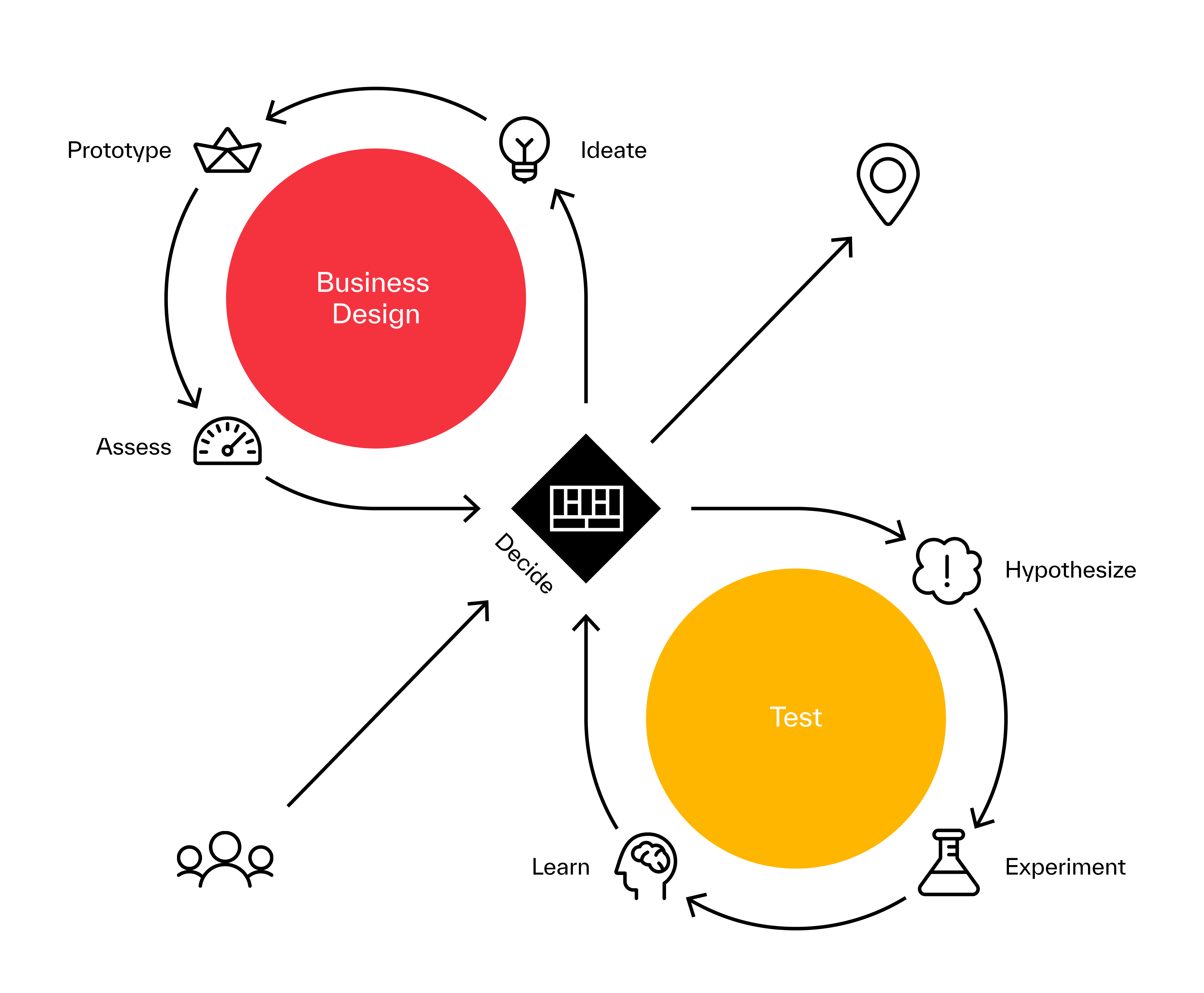
I. Business Design Loop
- Step 1: brainstorming
In this initial phase, as many business ideas as possible are developed in order to transform initial intuitions or findings into valuable business concepts. - Step 2: Prototype
The most promising concepts are selected and transformed into initial business prototypes. Initially, these may be simple mock-ups, but later tools such as the Value Proposition Canvas or Business Model Canvas are used. Minimum viable products (MVPs) are also created. These simplified versions enable valuable customer feedback. - Step 3: Assessment
The prototypes created are critically examined: Do they optimally address customer needs? Is the idea presented successfully? Do they adequately take into account the test findings? This evaluation is followed by either field tests or further iterations.
II. Test Loop
- Step 1: Formulating hypotheses
Every business idea is based on assumptions about market reactions, customer perception and demand volume. These assumptions must be formulated as clear hypotheses so that they can be specifically tested. - Step 2: Experimentation
The hypotheses are now tested in practice. Various methods such as surveys, interviews, prototype tests or A/B tests measure the reactions of potential customers. The feedback collected is used to optimise ideas or make fundamental adjustments. - Step 3: Learning phase
The test results are analysed comprehensively. The focus is on both quantitative data and qualitative findings from customer feedback and observations. The strengths and weaknesses of the business idea are identified and appropriate adjustments are made. - Step 4: Decision-making
Based on the data and insights gathered, an informed decision is made about the viability of the business idea. Positive test results justify moving on to the implementation phase, while clear warning signs require revision or reorientation.
The iterative nature of Business Idea Testing requires a decision to be made after each test phase regarding further adjustments, additional tests or the transition to implementation.
Test Cards & Learn Cards structure this process. They help to clearly define hypotheses, test variables and expected results, and ensure systematic planning and meaningful results.
Benefits of systematic business idea testing
The systematic review of business concepts brings significant benefits to both established companies and young startups. A methodical approach not only reduces risks, but also sustainably improves the chances of success.
- Minimize risks:
By testing business ideas at an early stage, potential weaknesses are identified before major investments are made. - Cost savings:
Negative developments are stopped at an early stage — this significantly reduces financial losses. - Customer focus:
Involving relevant target groups ensures that products and services meet real customer needs. - Efficient use of resources:
Time, budget and energy only flow into ideas with validated potential for success. - Fostering innovation:
Through experimental testing, different approaches can be tried out and creative solutions promoted. - Data-based decisions:
Hypotheses are tested empirically — strategic decisions are based on facts, not just assumptions. - Increased opportunities for market success:
Verified business ideas are significantly more likely to establish themselves on the market.
Conclusion
Business Idea Testing is an indispensable component for the efficient evaluation of the potential of new business ideas. It enables the validation of concepts and the early detection of errors before major investments are made. A structured approach minimises risks and significantly maximises the chances of success. The iterative nature of the testing process requires continuous feedback management and constant optimisation of the business idea.
Would you like to know how you can systematically validate new business model ideas? Then get in touch with us – Leading Lights offers tried-and-tested innovation formats such as Digital Business Model Validation, Innovation Factory and Design Thinking to transform ideas into successful business models.
Picture: © Illustration of business plan / rawpixel.com