From complexity to Clarity: How APM and Ardoq are Paving the Way to Modern Enterprise Architecture

Introduction
IT landscapes in companies are rarely the result of a clear master plan. Rather, they have grown organically over years, sometimes decades. New departments, requirements or technologies – and each time something is added: a tool here, a system there, a temporary workaround that ends up staying. The result is not a clean architecture, but an ecosystem of applications, interfaces and dependencies that is often difficult to understand. For many companies, this growing complexity has long since become a stumbling block.
At the same time, pressure is mounting: IT costs must be reduced, modernisation is pending, regulatory requirements are increasing, and specialist departments expect fast, flexible solutions. In short, the demands on IT and business are higher than ever, but the basis on which decisions are made is often surprisingly shaky.
This is where we at Leading Lights come in with our partner Ardoq and its Application Portfolio Management (APM) tool: APM is the key to bringing order to the growing IT landscape, creating lasting transparency and making data-based decisions.
Situation: a patchwork quilt of applications
When looking at medium-sized or large companies today, one often finds the same picture: a heterogeneous application landscape that has developed over many years with different technologies and providers, overlapping functions, and documentation that is often scattered across wiki pages, documents, or in the minds of individual employees.
In Practice that means:
- No one knows exactly how many applications there actually are.
- Many systems perform similar tasks without anyone noticing.
- Licences are paid for twice or not used
- Dependencies between systems are unclear.
The consequences can be enormous: studies show that companies run on average 20 to 30% more applications than they actually need. Apart from the costs, this slows down processes, complicates modernisation and increases security risks.
Complication: lack of overview, increasing risks
Without a clear overview, every decision is a shot in the dark: a project to replace an old system can destroy dependencies without anyone noticing, a cloud migration can come to nothing because no one knows which old applications are still connected to it – these and similar uncertainties can lead to three key problems:
1. High costs and technical debt
Unnecessary applications, duplicate licences, or unused systems drive up operating costs. In addition, a massive mountain of technical debt can accumulate over time: old technologies, manual processes, lack of standards. The result: IT becomes a cost driver instead of an enabler.
2. Low agility
If every project begins with a laborious analysis of dependencies, momentum is lost: teams become cautious and innovation stalls because no one wants to take the risk of unintentionally destabilising an important system. IT becomes a ‘black box’ and the organisation loses its adaptability.
3. Lack of data basis for decisions
In many companies, decisions are still made based on gut feeling, Excel sheets or outdated inventory lists. This may work on a small scale, but in a complex system with hundreds of applications, it can inevitably lead to wrong decisions.
Solution: transparency through application portfolio management
Application Portfolio Management (APM) is the approach that can solve all these problems. It involves recording, evaluating and managing the entire application portfolio in a data-based, traceable and continuous manner.
A good APM should answer the following key questions:
- What applications are there in the company?
- What are they used for and by whom?
- What are the costs, risks and dependencies?
- Which systems are critical, redundant or outdated?
Once these questions have been clarified, companies can begin to actively shape their portfolio rather than just managing it.
The Benefits in Figures
Companies that systematically implement APM achieve measurable success:
- 15–30% cost reduction through consolidation and licence optimisation
- Reduction of technical debt by specifically replacing legacy applications
- Better decision-making quality thanks to up-to-date, linked data
- Accelerated transformation because risks and dependencies are visible
APM is therefore a prerequisite for implementing modernisation, cloud migration or innovation projects securely and efficiently. However, transparency is not a one-off task: it must be maintained, updated and integrated into the organisation. For APM to work in the long term, you need a tool that dynamically links data, reveals connections and grows with the organisation. At Leading Lights, we support you as a sparring partner to help you establish a sustainable process.
Sustainable APM: how do we keep everything under control?
This is where Ardoq comes in: Ardoq is not just a simple database for applications, but a living platform for enterprise architecture management (EAM) that combines technical information, business processes and strategic goals into a dynamic overall picture, essentially a digital twin of the organisation.
Instead of static tables or diagrams, Ardoq creates an interactive network of applications, processes, data and responsibilities. This is where the decisive step must be taken: APM must not only be documented, but also put into practice.
1. Automatic data collection and integration
Ardoq integrates seamlessly with existing systems – from CMDBs and cloud platforms to HR and financial systems. Information is automatically synchronised, kept up to date and made available centrally.
2. Making relationships visible
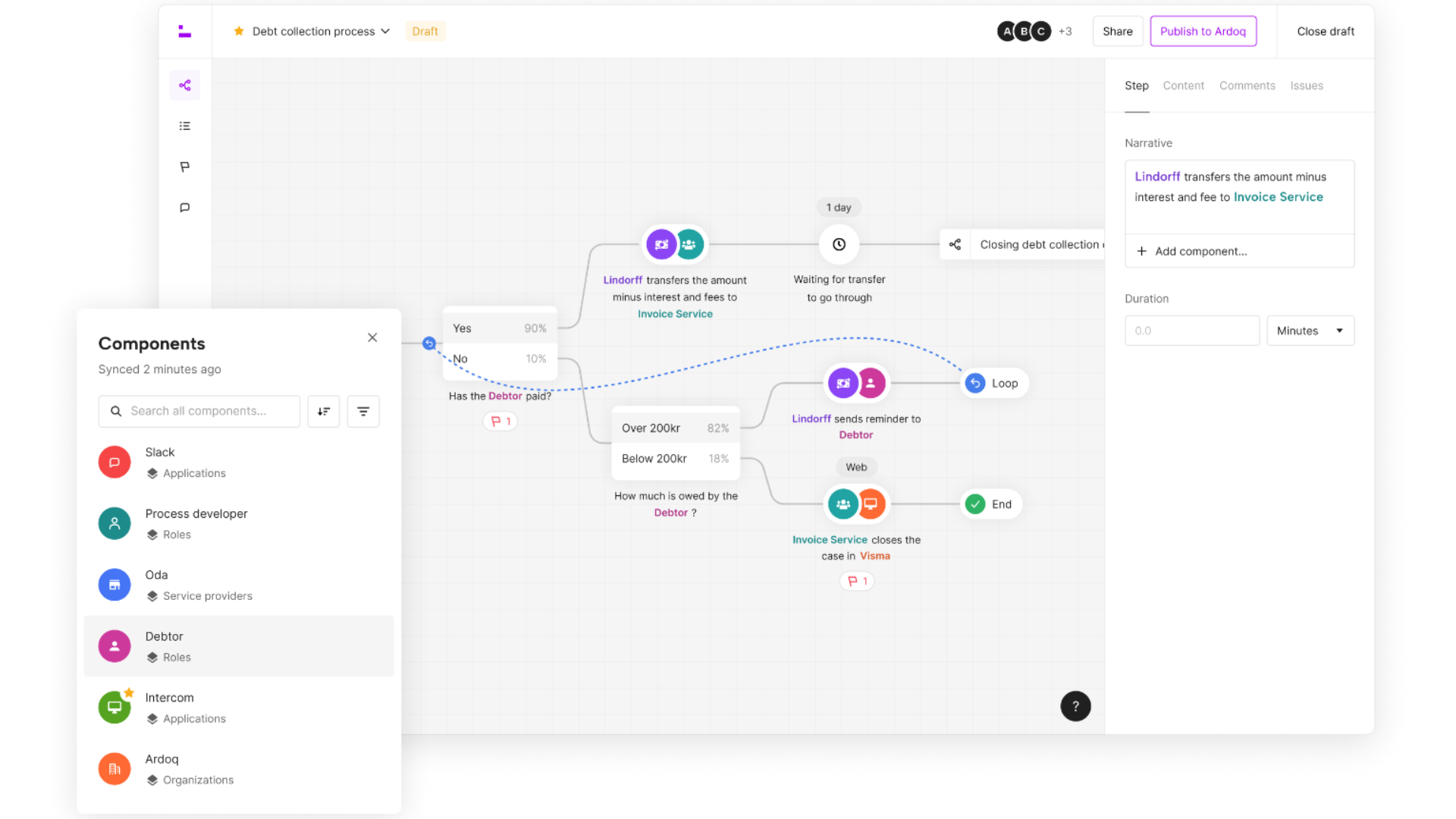
One of Ardoq's greatest strengths lies in the visualisation of relationships. Instead of static diagrams, the platform shows how applications are linked to each other, which processes they support and which data they use, opening up completely new perspectives: Which systems are connected to a critical application? What risks arise if it is replaced? Which business capabilities would be affected? Make visible
3. Actively involve all departments
Enterprise architecture only works if it is firmly established within the company. Ardoq offers collaboration features such as interactive surveys and dashboards that enable departments to contribute information themselves. This keeps the model up to date and shares responsibility for data quality.
4. Making decisions comprehensible
Every change, every consolidation, every modernisation can be simulated in Ardoq: impact analyses and scenario models reveal which systems, processes or teams are affected. This makes decisions transparent and allows risks to be quantified.
5. Ardoq as a strategic management tool
Ardoq creates a digital twin of the organisation: a living model that shows what you have, why it exists and how it can be used strategically. This is essential, especially in times of cloud transformation, AI integration and increasing security requirements, as without this view you are flying blind. And best of all, Ardoq grows with you: new use cases, frameworks and governance processes can be flexibly integrated and scaled.
Conclusion
At Leading Lights, we are delighted to have Ardoq as a strong partner in our portfolio. Together, we support companies in making their architecture transparent, secure and future-proof. With best practices, methodological expertise and comprehensive tool experience, we ensure that Ardoq is successfully anchored not only technically but also organisationally – for sustainable success and a future-proof IT landscape.
Modern application portfolio management is much more than just an inventory project. It marks the beginning of a new way of thinking about IT and business: data-driven, transparent and strategic. Together with Leading Lights, APM with Ardoq becomes a continuous process in which data is automatically updated, relationships become visible and decisions become traceable. In this way, we create a stable basis for our customers on which changes such as cloud migration, cost optimisation, AI integration or security strategies can be managed in a targeted and secure manner.
APM impresses with its pragmatism and immediately recognisable added value: with Leading Lights at your side, you can pursue the clear goal of creating transparency, connect business and IT in a natural way, and lay the foundation for all further steps – from architecture governance to digital transformation.
Picture: © Business Process Transformation Capabilities / ardoq.com