Process Mining: Unlocking Hidden Potential in Business Processes with Celonis as a Practical Example

Introduction
Every day, countless business processes run across a wide variety of systems in companies: orders are entered, jobs are approved, goods are produced, invoices are created. These processes form the backbone of operational performance – but in practice, they often do not correspond to the idealised target state. Deviations, inefficiencies and unexpected process variations are the order of the day.
This is precisely where Leading Lights comes in: as experienced consultants, we support companies in bringing transparency to their processes using modern process mining methods such as Celonis, uncovering potential for optimisation and implementing sustainable improvements. Together, we lay the foundation for setting yourself apart from the competition, improving customer experiences and making optimal use of resources.
Process mining is a technology that enables processes to be viewed as they actually occur – based on real data. This gives companies a transparent, objective and holistic view of their processes. In addition, process mining allows deviations, bottlenecks and potential for improvement to be identified in a targeted manner, enabling companies to optimise their processes, make them more efficient and achieve real competitive advantages.
As-is State: Complex Process Landscapes in Companies
In many organisations, process landscapes have grown over many years. Different systems – such as ERP, CRM or individual IT solutions – map individual process steps. These sub-processes are interlinked, but the resulting process chain is rarely visible throughout.
This results in silos, media discontinuity and manual workarounds. Even well-documented target processes often deviate significantly from the actual workflow. Processes are ‘alive’ – they change as a result of new requirements, individual working methods or ad hoc decisions.
Traditional analysis methods such as workshops or interviews quickly reach their limits because they often provide only fragmentary, subjective impressions – not the complete, data-supported reality. This makes it almost impossible for those responsible to maintain a complete overview or make targeted adjustments.
The Challenge: Lack of Transparency and its Consequences
When processes are not clearly visible, potential inefficiencies remain hidden. Decisions are often made based on gut feeling rather than objective data. This leads to several problems:
- Hidden process costs due to delays, dependencies, duplicate work steps or manual workarounds.
- Loss of control because operational management acts without real-time information.
- Compliance risks if deviations from rules are not detected.
- Missed automation potential because unclear process landscapes prevent the targeted identification of suitable use cases.
All in all, this not only results in efficiency losses, but also strategic risks: if you don't know your processes, you can neither optimise them nor successfully transform them digitally.
Die Lösung: Process Mining als Game Changer
Process Mining bietet einen neuen, datengetriebenen Blick auf Unternehmensprozesse. Statt sich auf Annahmen oder Einzelinterviews zu stützen, wertet die Methode digitale Spuren systematisch aus, die jede Aktivität in IT-Systemen hinterlässt. Diese Event Logs bilden die Grundlage, um Prozesse End-to-End faktenbasiert zu rekonstruieren.
Die Vorteile liegen auf der Hand:
- Transparenz in Echtzeit über den tatsächlichen Prozessverlauf.
- Erkennung von Varianten, Engpässen und Abweichungen, die in klassischen Analysen verborgen bleiben.
- Gezielte Optimierung auf Basis objektiver Daten statt subjektiver Wahrnehmung.
- Kontinuierliches Monitoring, um Verbesserungen nachhaltig zu verankern und Compliance sicherzustellen.
Process Mining wird damit zum strategischen Werkzeug, das operative Exzellenz und Digitalisierung entscheidend beschleunigt.
Celonis: Process Intelligence in Practice
To realise the full potential of process mining, powerful platforms are needed that seamlessly combine data integration, analysis and automation. Celonis has established itself as one of the leading providers in this field.
The Celonis Process Intelligence Platform has a clear goal: to make business processes visible, uncover inefficiencies, optimise them in a targeted manner and track optimisations in a measurable way. To achieve this, it combines data integration, intelligent analysis functions and automation mechanisms in a centralised, interlinked solution.
Data Integration: The Basis for Transparency
The first and most important step in process mining is to collect all relevant data sources and consolidate them into a consistent data model. This is the basis for accurate analyses and informed decisions. Celonis offers a flexible ETL (Extract, Transform, Load) framework that allows systems such as SAP, Salesforce, Jira and many others to be connected using pre-built connectors. The platform also supports the integration of individual IT solutions via standardised interfaces such as SQL, HTTP or Kafka.
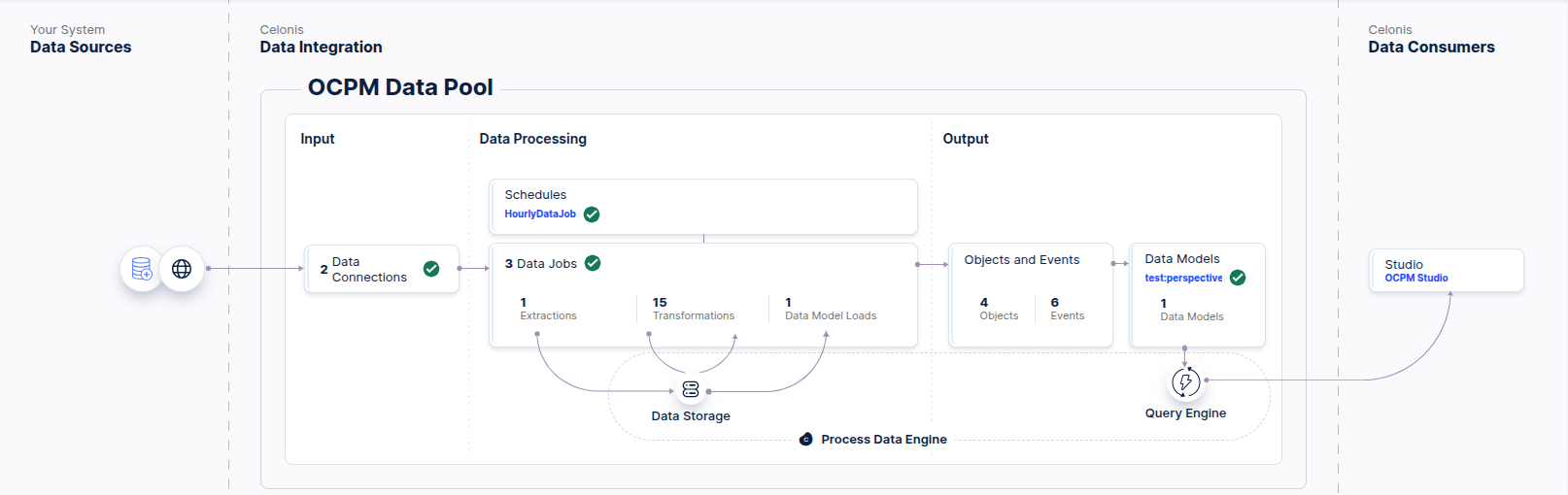
The collected data is transferred to a uniform data model consisting of activity tables (event logs), case tables and metadata. Celonis provides an integrated environment for this purpose, in which the necessary data transformations can be implemented using no-code or low-code configurations. This creates a robust, consistent database that forms the foundation for all further analyses and optimisations.
Celonis supports both the processing of real-time data for immediate monitoring, error analysis and process automation, as well as the import of complete data sets over longer periods of time. These are loaded as a comprehensive object model and enable in-depth analysis of processes from different perspectives.
Process Analysis and Optimisation: From Data Model to Tangible Insights
Processes in Celonis can be comprehensively analysed on the basis of the data model. This makes actual processes transparent, deviations visible and their effects measurable. On this basis, optimisations can be specifically planned and evaluated.
A key element of the analysis is the development of a Knowledge Model. This model derives company-specific key figures and filter logic, which then serve as the basis for further analysis tools. This ensures that all evaluations are based on uniform KPIs and can be interpreted consistently.
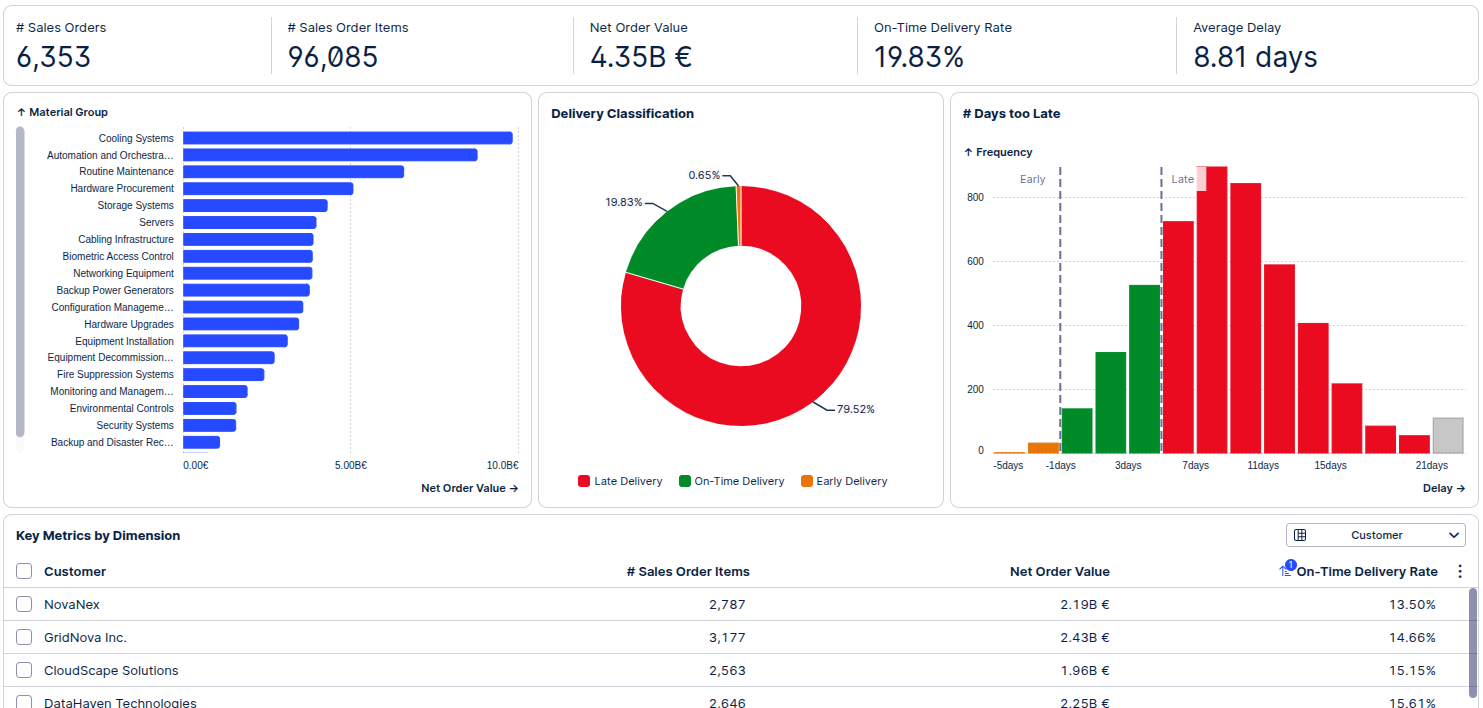
Based on this, interactive dashboards can be created for operational and strategic decision-making. Flexible filter and drill-down functions allow specific subsets – such as certain product groups, regions or process variants – to be viewed in detail. This reveals how individual process components affect key performance indicators such as throughput times, adherence to deadlines or turnover. Managers can thus precisely isolate bottlenecks or deviations and prioritise them based on facts.
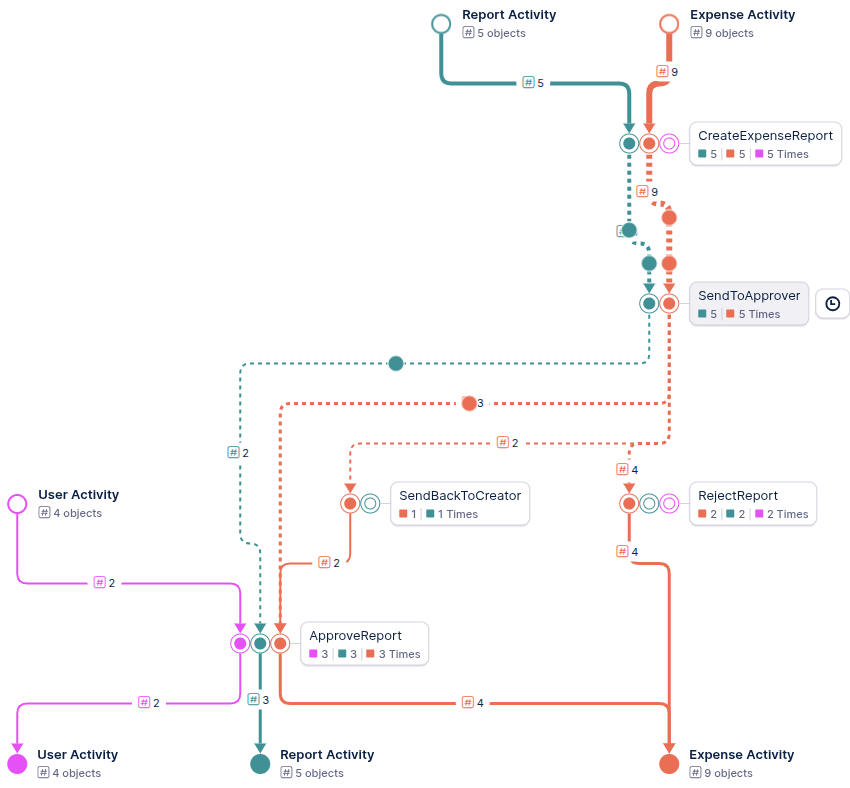
The Process Adherence Manager is available for comparing the defined target process with the actual process (see Chapter 9). It highlights gaps, deviations and unexpected process paths and shows how these affect defined KPIs.
AI-supported analysis functions are also available, particularly via Insight Explorer. This tool can automatically identify problematic process variants, calculate their impact on relevant key figures and generate specific suggestions for improvement. This allows optimisation potential to be identified much more quickly and precisely than with traditional methods.
With Process Copilot, Celonis offers an intuitive way to work directly with process data. Using a chat interface, users can ask questions about the data model, initiate analyses, or create new dashboards, diagrams, tables, and key figures via text input. This facilitates access to complex evaluations, even for departments without in-depth technical knowledge. Analyses that previously had to be configured manually in a time-consuming process can now be generated quickly and flexibly.
This provides a comprehensive picture of the actual process, which not only reveals weaknesses but also provides concrete starting points for improvements – which can be implemented immediately.
Automation and Monitoring: From Insight to Implementation
One of Celonis' key advantages is the close link between analysis and implementation. This means that a single platform can be used not only to analyse processes, but also to initiate concrete improvements – both in the form of automations within Celonis and through measures outside the platform, such as adjustments to business processes. The impact of these measures can then be systematically evaluated. Analysis, derivation of measures, execution and measurement of success are seamlessly integrated.
Action Flows can be used to define workflows based on the analysis results and connect them to external systems. For example, tasks can be created automatically, notifications sent or follow-up processes triggered when certain events occur. These automations can be time-controlled or real-time, enabling identified potential for improvement to be immediately transferred into operational processes.
The Transformation Hub complements this approach with a structured control and performance measurement level. Here, expected behaviour and benefits – such as improved delivery times or cost savings – are defined, optimisation initiatives are prioritised and their implementation is tracked transparently. In addition, the effects achieved can be quantified and compared with the potential originally identified. This makes it possible to see which measures are actually having an impact.
Deep Dive: Process Adherence Manager
A key tool within Celonis is the Process Adherence Manager, which can be used to systematically compare defined target processes with actual processes. This reveals where processes deviate from the desired paths and how these deviations affect performance.
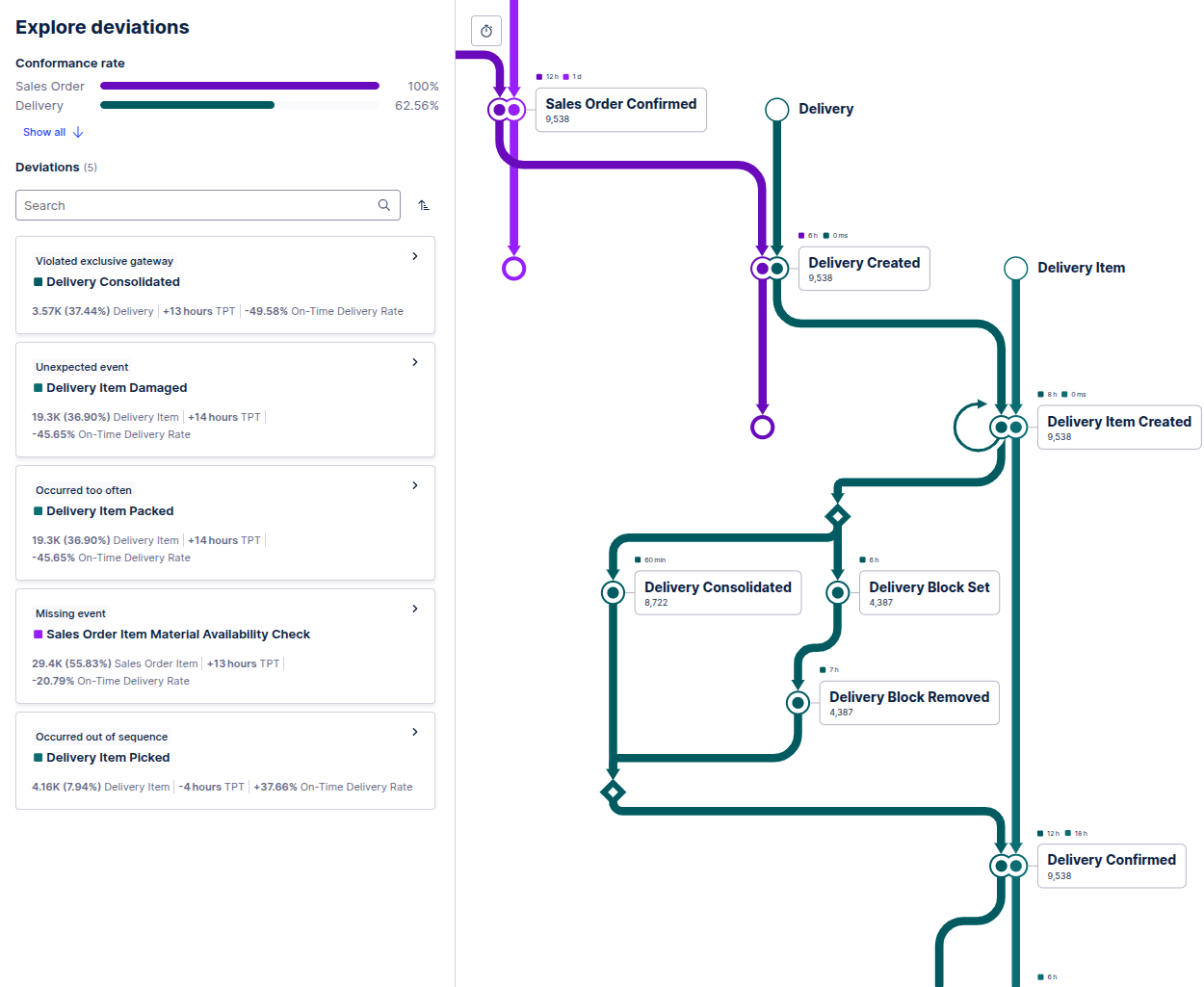
First, a target process is modelled – for example, in BPMN – and it is determined which process paths are desirable and which are undesirable. The Process Adherence Manager then analyses how often actual processes deviate from these specifications. Unexpected paths, omitted steps or loops are automatically detected and evaluated in terms of their impact on key performance indicators such as throughput times or adherence to deadlines.
The tool thus enables a detailed target/actual analysis that goes beyond mere process visualisation. Deviations are not only identified, but also quantified in terms of their relevance, making them easier to address in a targeted manner. On this basis, companies can clearly understand where process deviations occur, how severe their impact is, and where measures are most effective.
Conclusion and Outlook
Process mining is a powerful tool for making business processes visible, efficient and controllable. It creates the basis for achieving operational excellence based on data – far beyond what traditional process analyses can achieve.
Celonis provides a platform that implements this approach holistically: from data integration and analysis to automation. This enables companies to:
- Measurably reduce inefficiencies,
- Ensure compliance,
- Identify and take advantage of automation potential,
- and strategically manage their processes.
Leading Lights accompanies you on this journey – from the initial potential analysis and implementation to the sustainable anchoring of process mining in your company. Together, we develop a customised process intelligence strategy that delivers real, measurable results.
Would you like to know how Process Mining can unlock hidden potential in your company?
Please feel free to contact us for a no-obligation initial consultation – we look forward to supporting you on your path to operational excellence!
Pctures: © Screenshots Celonis & Celonis Academy Program